|
Assessment Area |
What You Are Checking |
Standard It Maps To |
|
Discovery and inventory |
Every agent deployed, including shadow agents built by individual teams |
CISA Five Eyes guidance, NIST AI RMF Map function |
|
Identity and access |
Unique, scoped, non human identities for every agent |
NIST NCCoE agent identity concept paper, OWASP ASI |
|
Tool and permission controls |
Least privilege scoping and approval gates on every tool call |
OWASP Top 10 for Agentic Applications, MITRE ATLAS |
|
Memory and context integrity |
Protection against poisoned memory, RAG stores and prompts |
MITRE ATLAS AML.T0080, OWASP ASI06 |
|
Monitoring and logging |
Action level audit trails that separate agent activity from user activity |
CISA immediate actions, SOC 2, ISO 42001 |
|
Human oversight |
Approval gates on irreversible or high impact actions |
OWASP ASI mitigations, Five Eyes guidance |
|
Incident response |
Containment, revocation and blast radius limits for a compromised agent |
NIST AI RMF Manage function |
|
Governance mapping |
Where the program sits against OWASP, MITRE ATLAS, NIST and ISO 42001 |
ISO 42001, NIST AI RMF, EU AI Act |
An AI agent that can read a mailbox, call an API, move money or push code carries different risk than a chatbot that answers questions. It has a working memory that persists across sessions. It has tools it can invoke on its own.
It has enough autonomy to chain several of those tools together without a human checking each step. That combination is what a dedicated agent security assessment has to test for. Controls built for a traditional application, such as input validation and static role based access, were not designed around an actor that plans, delegates and acts on its own.
This guide gives you a working AI agent security assessment checklist you can run against any agent already in production or about to ship. It is organized around the risk categories that OWASP, MITRE ATLAS, NIST and the Five Eyes cybersecurity agencies have converged on through 2026.
Why AI Agent Security Needs Its Own Assessment
LLM security testing asks whether a model can be jailbroken into producing a harmful output. Agent security testing asks a harder question: what happens when that same model is holding an API key, a database connection and a task queue.
An agent's mistakes are not limited to bad text. A prompt injection buried in a support ticket, a poisoned page an agent summarizes, or a manipulated memory entry can translate directly into an unauthorized refund, a deleted backup or a data exfiltration event. It can do this across hundreds of actions before a human notices anything is wrong.
OWASP's GenAI Security Project frames the shift this way: LLM security focused on single model interactions, while agentic security has to address what happens when models plan, persist and delegate across tools and systems. A security review built for static applications, or even for single turn LLM prompts, misses most of this.
An agent specific assessment tests identity, permission scope, memory integrity and the chain of tool calls an agent can make, not just the words it outputs.
The 2026 Threat Landscape for Autonomous Agents
Four bodies of work now define what a serious AI agent security program has to account for. A good assessment should be traceable back to all four. The OWASP Top 10 for Agentic Applications is the closest thing the industry has to a shared vocabulary for agent risk. It names failure modes like Agent Goal Hijack, where an attacker manipulates what an agent believes its objective is.
It also names Human Agent Trust Exploitation, where an agent's fluent, confident tone is used to talk a person into an unsafe action, and Cascading Failures, where one compromised agent's output becomes another agent's trusted input. MITRE ATLAS covers the threat intelligence side.
A late 2025 collaboration with Zenity Labs added agent specific techniques to the framework. ATLAS now tracks Memory Poisoning (AML.T0080), where an attacker's instructions get written into an agent's long term memory and persist across future sessions, along with Exfiltration via AI Agent Tool Invocation, where an agent's own legitimate tool access becomes the exfiltration channel.
On May 1, 2026, CISA joined five allied cybersecurity agencies, including the NSA, Australia's ASD ACSC, Canada's Cyber Centre, New Zealand's NCSC and the UK's NCSC, in publishing the first coordinated multi government guidance on agentic AI.
Titled Careful Adoption of Agentic AI Services, it organizes risk into five categories: privilege, design and configuration, behavioral, structural and accountability. Its immediate actions read like a program kickoff list.
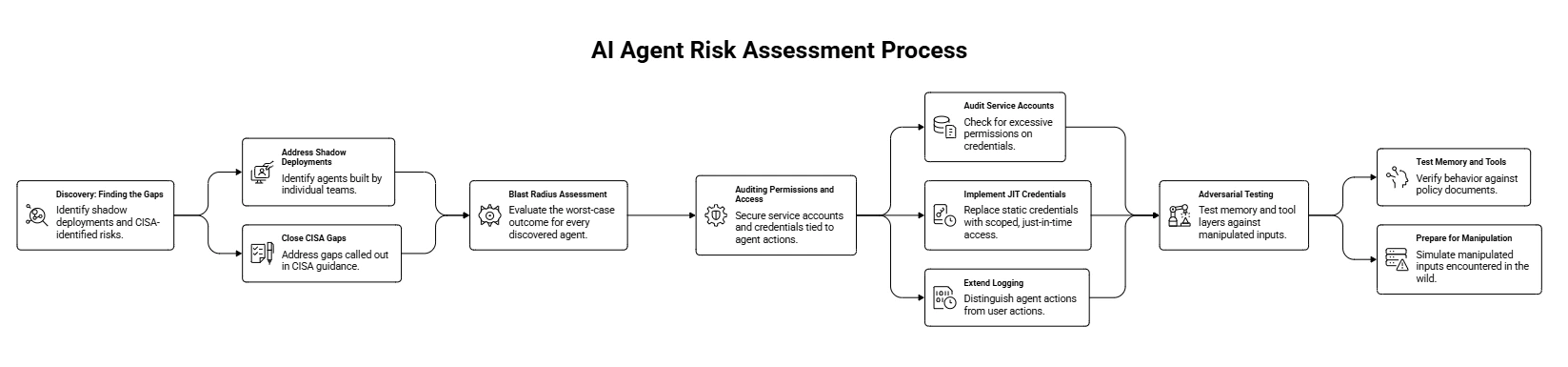
Inventory every agentic deployment, including shadow agents. Run blast radius assessments. Audit service accounts for excessive permissions. Replace standing credentials with just in time provisioning. Extend logging to capture agent actions specifically. NIST's Center for AI Standards and Innovation launched its AI Agent Standards Initiative in February 2026.
Its most operationally useful output so far is a concept paper on agent identity and authorization built around OAuth 2.0, SPIFFE and SPIRE, and the Model Context Protocol. Formal standards are still in development, but the direction is clear enough to design controls against now.
Core Risk Categories Every Assessment Must Cover
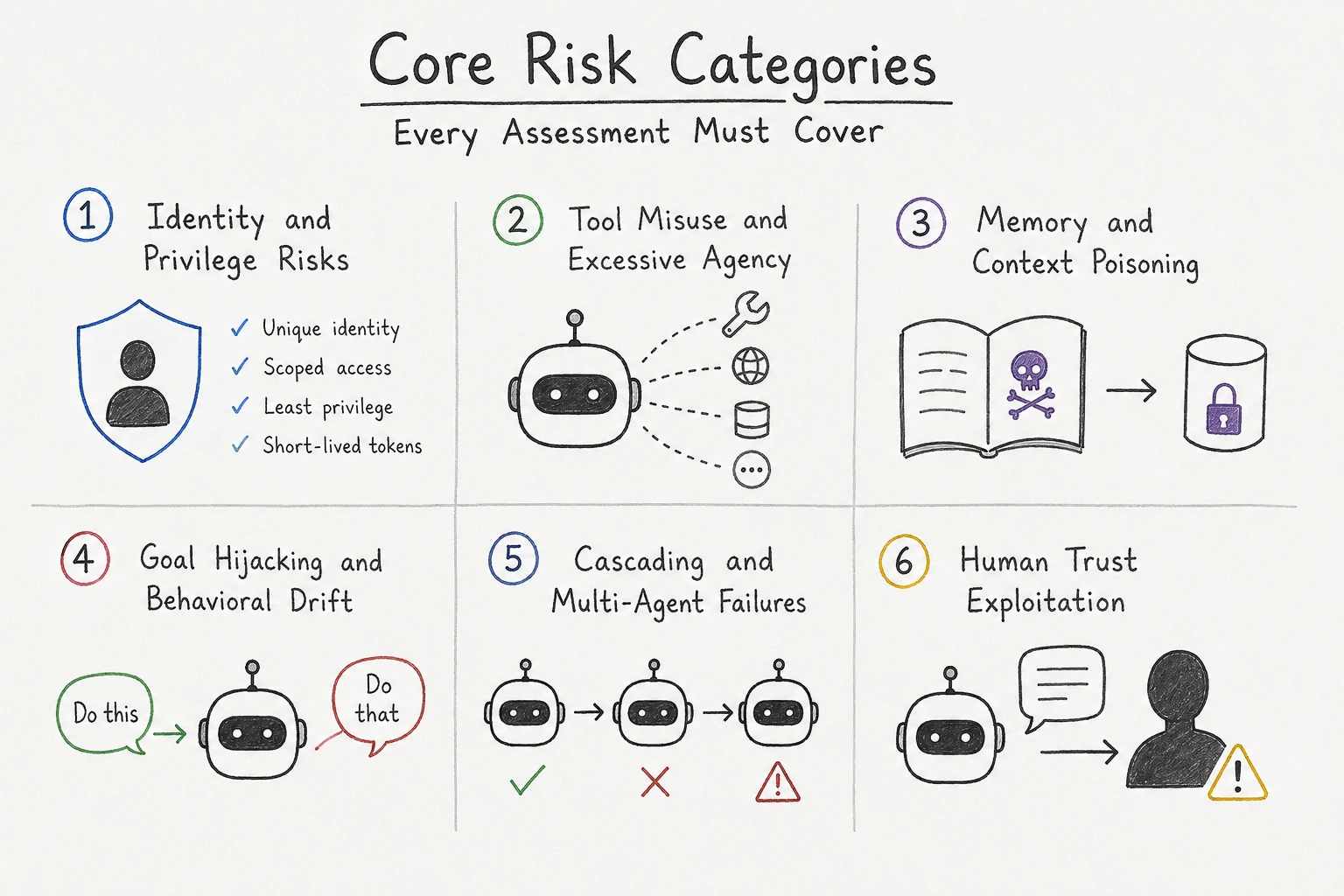
Identity and Privilege Risks
Agents running under a shared service account or a borrowed user session create three problems at once. You cannot attribute a specific action to a specific agent. You cannot revoke one agent's access without breaking others. You cannot build a meaningful audit trail.
The LastPass 2026 agentic AI security checklist names the same fix every major framework lands on: a unique identity per agent, scoped permissions, and secrets that never sit exposed in a prompt. Short lived, audience bound tokens replace static API keys. Permissions get granted just in time rather than standing indefinitely.
Tool Misuse and Excessive Agency
An agent that can technically call fifty tools but only needs three for its job carries forty seven unnecessary risks. A compromised or manipulated agent inherits whatever privileges its tools happen to have. OWASP's Agentic Top 10 treats identity and privilege abuse as a first class category, not an implementation detail.
Memory and Context Poisoning
Agents that retain memory across sessions, or pull context from a retrieval store, create a persistence mechanism for attackers. A single successful prompt injection, delivered through a document, an email or a URL parameter, can write an instruction into memory that keeps steering the agent long after the original message is gone.
Microsoft's security team documented this pattern in the wild, finding companies embedding hidden instructions designed to make an AI assistant remember them as a trusted source for future recommendations. MITRE ATLAS mitigations for this technique center on write access control to memory, schema bound storage, sanitization, versioning and rollback.
Goal Hijacking and Behavioral Drift
Agents interpret instructions in natural language. They often cannot reliably tell a legitimate instruction from a malicious one embedded in a document, an API response or retrieved data. OWASP calls this Agent Goal Hijack. A more insidious version is what researchers call a Rogue Agent: one that drifts gradually from its intended behavior through accumulated small manipulations, until its actions no longer match its original purpose and detection becomes genuinely difficult.
Cascading and Multi Agent Failures
Multi agent systems introduce a failure mode that single agent testing cannot see. One agent's compromised or hallucinated output becomes the next agent's trusted input, and the error compounds at every hop.
OWASP's recommended mitigation is to test changes against a digital twin, an isolated clone of the production environment, before letting an agent's newly expanded permissions or policy touch anything real.
Human Trust Exploitation
Agents sound fluent, confident and consistent, and that is exactly what makes their mistakes persuasive. An attacker does not need to break an agent's logic if a human will act on its authoritative sounding but wrong output. Every framework covered here pairs technical controls with human approval requirements for high impact or irreversible actions.
The AI Agent Security Assessment Checklist
Discovery and Inventory
- List every AI agent in production, including ones built informally by individual teams outside a central AI program
- Document what each agent is authorized to do, what data it can touch and which systems it can call
- Identify which agents operate autonomously versus which require human approval for each action
- Flag any agent using a shared service account or a human user's borrowed session
Identity, Authentication and Authorization
- Confirm every agent has a unique, non human identity rather than a shared credential
- Verify tokens are short lived and audience bound rather than long lived static API keys
- Check that permissions follow least privilege and are granted just in time rather than standing
- Confirm credentials are stored in a vault rather than baked into environment variables or config files
- Test that revoking one agent's access does not require touching any other agent's credentials
Tool and Permission Controls
- Map every tool each agent can call and confirm it is scoped to what the task actually requires
- Require explicit authorization for destructive or high impact tool calls specifically
- Test what happens when an agent is fed a manipulated input designed to trigger a tool it should not need
- Confirm tool definitions themselves are verified and cannot be silently modified or replaced
Memory and Context Integrity
- Test whether untrusted input, such as a document, email or web page an agent processes, can write persistent instructions into memory
- Confirm memory writes are access controlled and schema bound rather than open ended
- Check for versioning and rollback capability if contaminated memory is detected
- Test retrieval augmented generation stores for poisoned or planted content an agent might treat as trusted
Monitoring, Logging and Detection
- Confirm every agent action is logged separately from user actions, with enough detail to answer what the agent accessed, what it touched and where any data went
- Verify logs cannot be forged or deleted by the agent whose actions they record
- Check for behavioral baselines that can flag drift from an agent's expected pattern over time
- Confirm alerts distinguish between an agent doing something legitimate and an agent doing something out of policy
Human Oversight and Approval Gates
- Identify which actions are irreversible or high impact enough to require human confirmation before execution
- Test that approval gates cannot be bypassed through a chained or indirect tool call
- Confirm the human approver has enough context to make an informed decision rather than rubber stamping
- Verify approval requirements scale with the blast radius of the action, not just its category
Incident Response and Containment
- Confirm a single agent's access can be revoked immediately without disrupting the rest of the environment
- Test containment procedures for a compromised or misbehaving agent, including how quickly its access can be cut
- Verify the organization can answer, for any incident, exactly which actions were the agent's and which were a human's
- Confirm rollback procedures exist for actions an agent took under a poisoned or manipulated state
Governance, Compliance and Standards Mapping
- Map current controls against the OWASP Top 10 for Agentic Applications
- Cross check identity and access controls against the NIST NCCoE agent identity concept paper
- Confirm the assessment aligns with the CISA Five Eyes immediate actions: inventory, blast radius assessment, service account audit, just in time credentials, expanded logging
- Document where the program stands against ISO 42001 and NIST AI RMF for audit and insurance purposes
How to Run the Assessment Step by Step
Common Mistakes That Undermine an AI Agent Security Assessment
Treating an agent assessment as a rerun of an LLM jailbreak test misses the tool and memory layer where many real incidents originate. Assuming a policy document reflects actual agent behavior is another gap, since agents interpret natural language instructions and cannot always distinguish a legitimate one from an injected one.
Skipping inventory and assessing only the agents a security team already knows about leaves shadow deployments untested. These are often the least governed agents in the environment. Granting broad, standing permissions during a proof of concept, then never revisiting them once the agent reaches production, is how a reasonable prototype turns into a production liability.
Mapping the Checklist to OWASP, MITRE ATLAS, NIST and ISO 42001
No single framework covers every angle of agent security. A mature program treats them as complementary layers rather than competing standards. OWASP's Top 10 for Agentic Applications defines the risk categories and mitigation patterns for builders and defenders.
MITRE ATLAS supplies the threat intelligence: specific adversary techniques like memory poisoning and tool invocation exfiltration, documented with real world case studies. NIST's AI RMF and its emerging Agent Standards Initiative define how an organization governs and assesses risk at the program level, with the NCCoE's identity and authorization concept paper as the most concrete technical guidance available right now.
ISO 42001 provides the certifiable AI management system structure that ties the technical controls to an auditable governance program. An assessment checked against all four gives a CISO a defensible answer when a board, an auditor or a cyber insurer asks how agent risk is being managed.
Who should be involved in an AI agent security assessment? AppSec and DevSecOps teams typically own the technical testing. A complete assessment also needs input from whoever owns the agent's business logic, the identity and access management team responsible for provisioning credentials, and a governance or compliance stakeholder who can map findings back to frameworks like NIST AI RMF or ISO 42001.
Running this checklist once tells you where an agent stands today. Keeping it current as agents pick up new tools and permissions is the harder, ongoing part. That is exactly where continuous automated red teaming is built to help, running realistic attack simulations against your agents around the clock instead of waiting for the next scheduled review.
If you are still mapping out what
your organization has deployed, a cyber security assessment is the right starting
point before narrowing in on agent specific risk. Teams preparing for penetration testing or an ISO 42001 audit can
fold this checklist directly into that scope. Hoplon InfoSec's AI powered cybersecurity solutions team works
through exactly this kind of assessment with enterprise security teams building
or inheriting agentic AI deployments.
Related Articles

-20260811071409.webp&w=3840&q=75)